

Good morning everyone.
Life’s been busy lately, which is why I’ve been a little MIA here. I’m sorry for the negligence. I’ll try to be a better leader. I know I haven’t always been there for you. But I’m trying now. I’m back on the straight and narrow.
In fact, I even found a support group for dads who just got out of prison and are trying to reconnect with their kids. I am not a dad, I do not have children, and haven’t been incarcerated. Not yet, at least.
But honestly, it’s the closest thing I could find to help me figure out how to reconnect with you all.
Anyway, I’m glad to be back. And your mother and I are going to see if we can patch things up.
I went to checkout the NYTs yesterday and was pleasantly surprised to see a MAHA piece as the cover story.
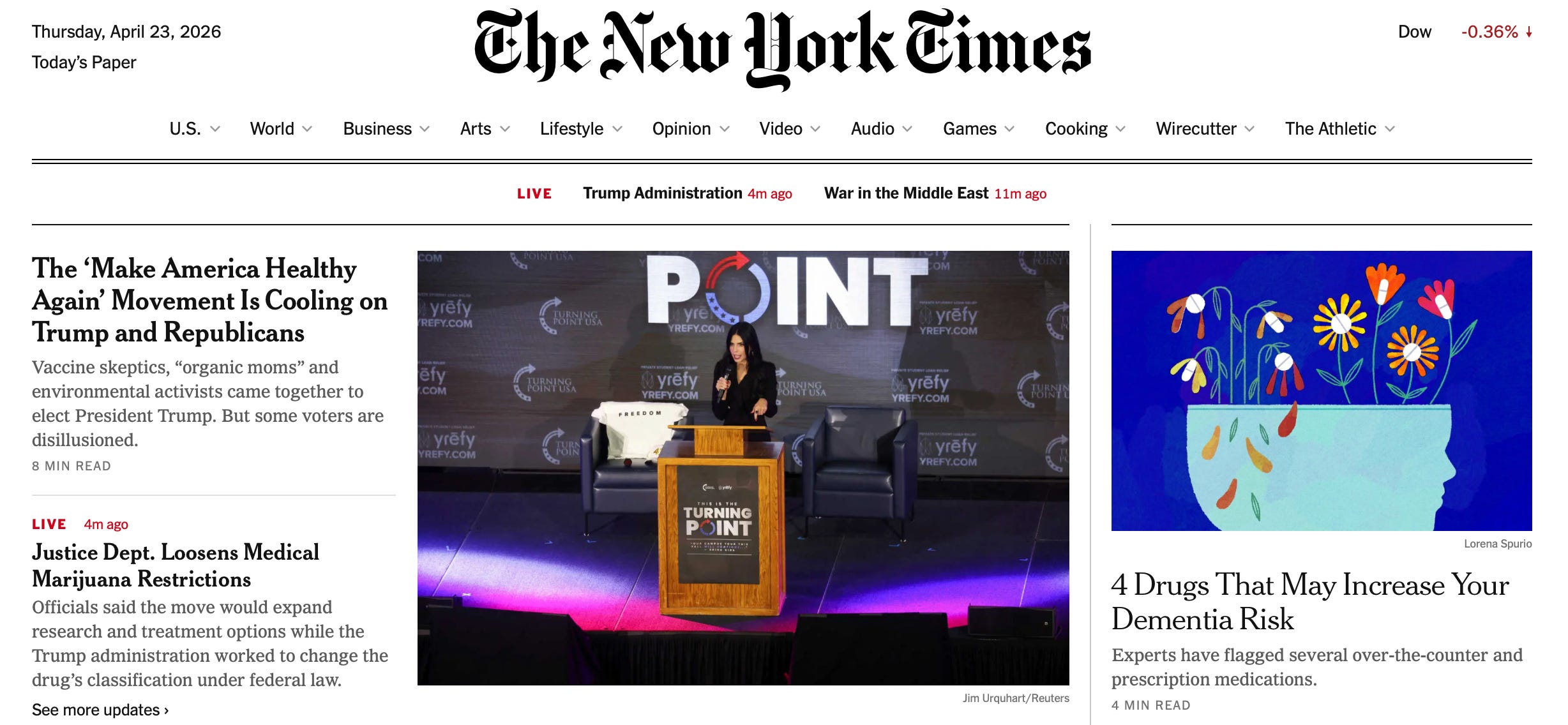
My favorite quote was from Alex Clark, a health podcaster who said that “Republicans would be stupid, moronic to let these voters just slip through our fingers.”
It’s fascinating, because this is the exact diction my girlfriend deploys when I add ingredients to a recipe that aren’t called for. She’s a stay-within-the-lines kind of girl when it comes to cooking. Me? I’m more free-spirited. I like to experiment. This is also known as “stupid, moronic.”
Anyway, it’s a great piece you can read here.
I went to dinner this week with a friend who was recently diagnosed with colon cancer.
I’ve read many reports about the disease’s rapid rise—about 1 in 25 men and 1 in 26 women will develop it, with incidence increasing roughly 3% each year—but this week I was struck by the humanity of it, sitting across from a middle-aged, otherwise healthy man facing a stage-four prognosis.
Fortunately, he has an excellent team of physicians and family around him, and he’s doing remarkably well. He’s hopeful.
Still, his diagnosis sent me back into the research. Why is colon cancer skyrocketing?
There are hundreds of papers investigating the question. Each offers a piece of the puzzle—but the overall picture is not nearly as mysterious or complicated as it’s often made to seem.
Essentially, we’re destroying our guts.
Like many cancers, colon cancer does not have a single cause. There is no sole perpetrator.
Researchers point to several contributors: the liberal use of antibiotics, ultra-processed foods, inactivity, pesticides, certain pharmaceuticals, and even specific viruses.
Together, these forces have bulldozed our microbiomes like a post-apocalyptic cityscape. They leave behind ecosystems that are depleted—dysregulated by a scarcity of beneficial bacteria and increasingly dominated by pathogenic species.
But fundamentally, a gut environment that fosters disease is not created overnight. It is shaped by decades of continual and invasive mistreatment. And among all these factors, the most influential is what we eat.
Are we eating foods that nourish the gut—foods that feed beneficial bacteria, introduce microbial diversity, supply essential nutrients, support digestion, and equip the immune system to disarm pathogens? Or are we feeding ourselves foods that do the opposite—foods that contain little life at all?
You may feel fine eating a muffin and a Starbucks coffee for breakfast. A Chipotle burrito or Chick-fil-A lunch may be convenient—and again, you feel fine, at least for now. A frozen pizza or DoorDashed dinner is easy and satisfying.
Life is good, you feel fine!
But these lifeless foods, compounded over years, refashion your gut so that what seems like diminutive changes are in fact tectonic.
Add to this repeated courses of antibiotics, chronic medication use, and pesticide exposure, and suddenly the terrain of the colon begins to resemble something closer to Chernobyl than a healthy ecosystem. Colon cancer does not arise from nuclear radiation, of course. But it manifests and thrives in environments that have been similarly stripped of their natural defenses.
When I think about the sudden rise of young people like me developing colon cancer, I consider what the average upbringing of my generation actually looked like—and I find myself thinking: well, of course. Did we really expect there would be no consequences from:
formula replacing early microbial exposure from breastfeeding?
Fishy crackers for toddlers?
Lunchables for elementary schoolers?
Taco Bell and energy drinks for high schoolers?
chronic exposure to glyphosate?
multiple courses of antibiotics every year in childhood?
We’re feeding ourselves dead foods.
There’s obviously the junk foods, but I’m also thinking of foods that may not contain many calories and that advertise themselves as good sources of fiber, calcium, whole grains, and so on. They may even be good sources of those things.
But whenever we’re grocery shopping, eating out, or preparing a meal, it’s Running On Butter’s standard that we ask a simple question:
Is this food full of life—or is it a dead food?
That may sound arbitrary or subjective. But I can promise you that once you start thinking through this lens, your God-instilled intuition begins to kick in.
And if you’re still unsure what I mean, cook for real flavor rather than what you’ve been told is healthy.
Think: fresh basil and cilantro tossed into a salad with olive oil and apple cider vinegar. Fresh raspberries in a bowl of yogurt with raw honey. Cinnamon sprinkled over sliced apples. A turmeric-ginger chicken curry simmering on the stove. Pulled pork taco bowls with fresh pico de gallo, homemade guacamole, and pickled onions.
An easy way to dramatically increase the life in your meals is simply adding a few spoonfuls of sauerkraut to your plate, as I do most days.
Again, you may be thinking: seriously? My best defense against cancer is a Granny Smith apple and some cilantro?
To that I would say: yes. Eating this way is exactly how you avoid giving cancer daylight.
One meal becomes a day of eating. A day becomes a month. Months become years. And years become decades.
Small, seemingly insignificant decisions—repeated over time—culminates in at the emperor of all maladies: cancer.
Freya India’s article on how social media is feminizing us all is excellent. “Indirect aggression, for example, is how girls typically fight; they are more likely to use tactics like passive-aggression, social exclusion and reputation destruction, rather than getting physical. But now boys are growing up doing the same.”
Fertility rates have dropped again. I don’t think you are to blame, given that my core readership consists mostly of moms with at least four children.
Remember when the grandson of Reese’s Candy blew the whistle on Hershey’s for not using real chocolate and peanut butter in their peanut butter cups? Well, the company heard his—and the public’s—complaints and announced it would be returning to real chocolate and peanut butter. (This is not Running On Butter endorsing candy bars. I just find the succession drama interesting.)
Pfizer had to cancel its trials for a new Covid vaccine because they couldn’t find enough willing participants. They should’ve asked me. I’d be curious to find out whether I got the placebo or not. I suppose if I developed myocarditis, that would settle it.
HHS is threatening to pull funding from hospitals if they don’t align their food with the updated dietary guidelines. Turns out Jell-O and pancakes with Aunt Jemima syrup are not exactly the recipe for healing.
Kylie Jenner has pivoted her vodka soda company into a hydration brand. The multi–plastic surgery patient is now reminding us that “beauty starts from within.”
Texas AG Ken Paxton is suing SHEIN, the Chinese clothing company that sells $4 sweaters, over alleged lead contamination. Our clothing safety laws haven’t been meaningfully updated since the 1940s—even though dozens of new synthetic chemicals are now routinely used in modern fabrics. It turns out many of these substances can be absorbed through the skin and pose health risks. RIP to my Lululemon collection.
Do yourself a favor and watch what is my new favorite surf doc:
Great read, part of me feels like we are doomed, part of me is hopeful. With you and Alex Clark I'm sure things will get worked out and America can be healthy again.
This is an excellent piece. Have you read Chris Beat Cancer? He would agree with you. But there’s an interesting bit in there where says to eat fermented food like sauerkraut and kimchi but also to be careful with amounts due to stomach cancer being higher in areas where lots of fermented foods are eaten regularly (Asian cultures he used as an example). He puts 1/4 cup of sauerkraut on his meals once a day I believe (fat check me on that) Anyway, it’s a great read! GREAT article! Thank you for writing!