

Good morning everyone.
Today we’re interviewing the founder of Lovebird Cereal, Parker Brook.
As you’re about to see, Parker’s a boss. He spent more than a decade at General Mills before becoming convicted by what Big Food was perpetrating against the American people. So he walked away and started Lovebird.
Before we go any further about my love letter to Lovebird, I must say: no, Lovebird is not a sponsor.
I reached out to Parker to write about Lovebird because my fandom, like its ingredients, is organic. It’s part of my nightly routine after dinner. Just ask Alexandra. She will testify to this habit. (a post-dinner snack/meal is something I only recommend for competitive athletes, just to be clear.)
In fact, I’m eating a bowl right now as I’m writing this piece.
I didn’t grow up eating cold cereal because my mom loved me. And by the time I became an adult, my convictions against processed food were pretty staunch. So I’ve never really eaten cereal—not because I didn’t like it, but because there was never a genuinely good, healthy version.
That is, until Lovebird entered the scene.
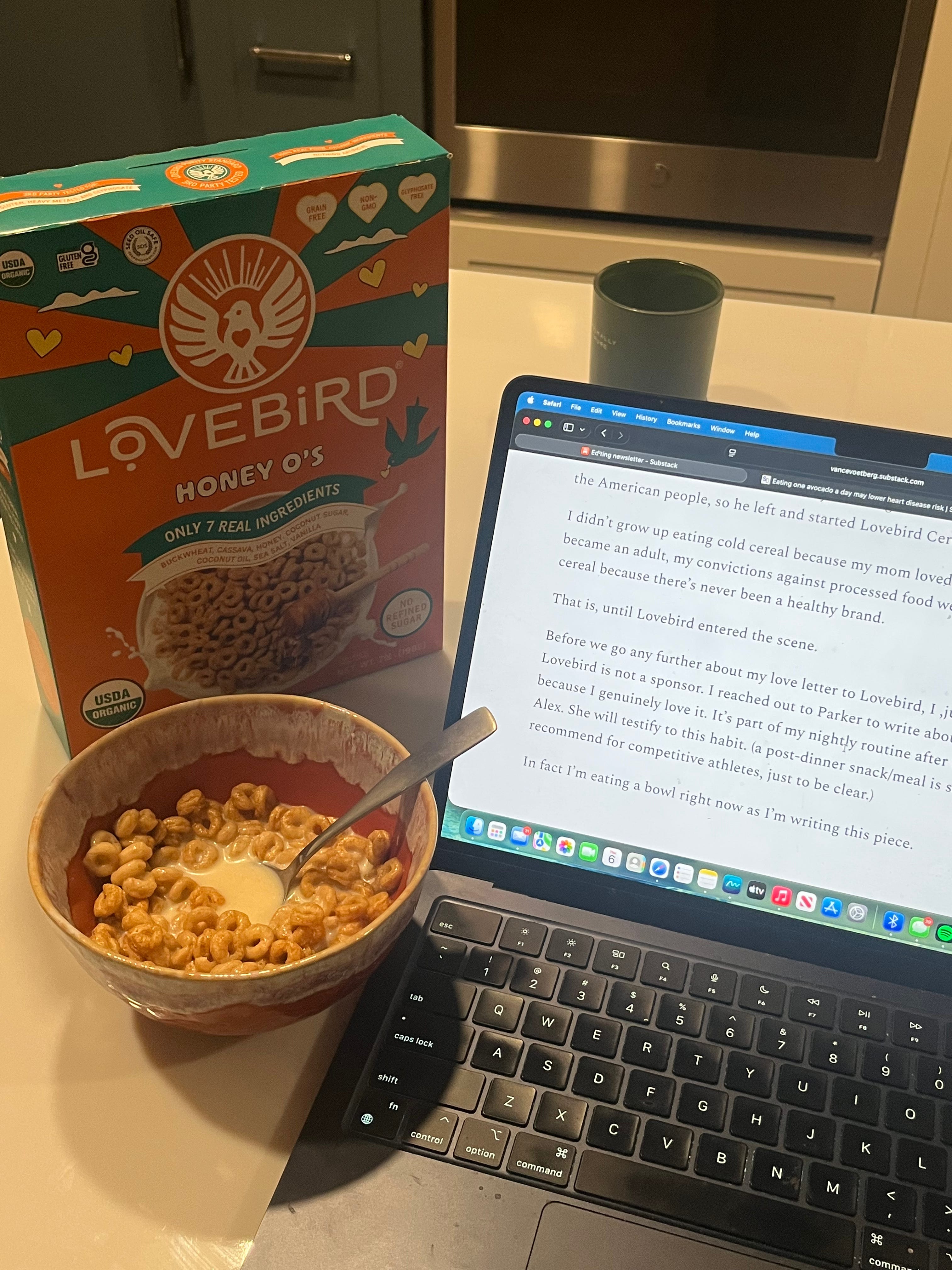
Brands like Lovebird are a rarity. They’re not just greenwashed hype. They don’t just tell you they’re healthy on the package (though their branding is brilliant, too); every ingredient they use is top-notch. No chemistry lab weirdness.
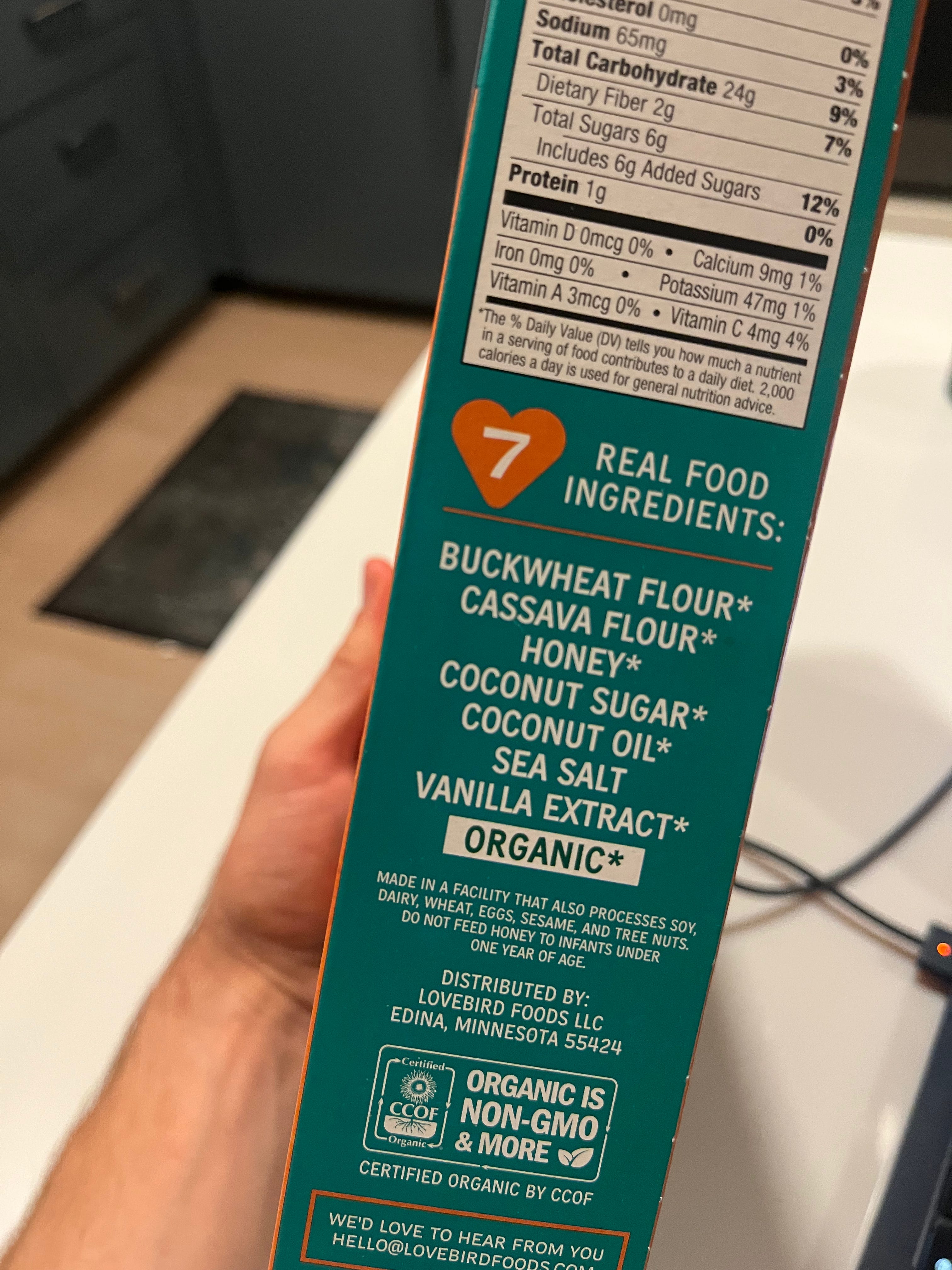
As if Lovebird wasn’t cool enough for creating a genuinely great product, they also set aside 20% of their profits to support families battling pediatric cancer. So yeah, the Lovebird team basically makes Mother Teresa look self-interested.
The Interview
ROB: You worked at General Mills for years—aka you were #PartOfTheProblem when it comes to Big Food’s assault on Americans’ health. What exactly was your job there? What did a typical day look like?
Parker: I managed brands like Cheerios, Yoplait, Nature Valley, and Totino’s Pizza Rolls. The job was to get people to eat more of your product and grow market share or “share of stomach.” You would have a team of 50-100 people working on ways to make products taste addictive, be within arms reach for shoppers, as cheap as possible, and spend millions of dollars on advertising. In the job, you view all consumers as a “number”, that you want to use to grow your brand and hopefully climb the ladder with a promotion. It’s very spiritually empty work selling a concoction of chemicals wrapped in calculated marketing engineered to drive over-eating.
ROB: What finally made you leave General Mills and start Lovebird?
Parker: My own personal health journey combined with the birth of my daughter. I felt like I was going through the motions and didn’t have alignment between my work and my values. I personally discovered the power of food as medicine and help manage my autoimmune disease. That discovery made me question the system and try to change it. When I became a dad a year later, my whole world change. That feeling of trying to make difference became my mission. I had a Jerry McGuire moment and left General Mills to save our food future - determined and hopeful.
ROB: I recently spoke with a Big Food executive who was in complete denial that the industry is fueling chronic disease. What’s going on inside these companies? Is it genuine denial? Willful blindness? Something else?
Parker: That’s the standard thought process. Most of these employees are brainwashed and in denial. They don’t do the mental math: highly addictive food + empty calories + super cheap prices = overeating and overconsumption of synthetic food additives leading to inflammation-driven chronic disease. Back in 90’s food industry executives had a secret meeting discussing this topic led by a whistleblower - nothing happened. Their paycheck depends on that statement not being true so it’s easy to turn a blind eye. It’s a harsh reality and they point their finger at “consumer choice” or “move more, eat less” to deflect responsibility.
ROB: Big Food loves to say, “We just follow consumer demand.” Skeptics—including this one—argue that consumer demand is often engineered by Big Food long before anyone reaches the grocery store. Do these companies merely respond to consumer behavior, or do they actively shape it?
Parker: In the glory days of Big Food, they absolutely created demand. Look at the invention of breakfast cereal, a food that previously did not exist, or the explosion of convenience food in the 70’s/80/s/90’s. Big Food spends $14 billion annually on advertising their franken-food (most of it geared towards moms), with $2 billion spent directly on advertising to kids. Now, Big Food is struggling as their old tricks don’t work - people have become smarter. It should be “we follower consumer demand when it fits our profit margins” - they do not care about consumer health just consumer consumption. That is a recipe for health disaster. All Big Food sales are declining so now they are buying “healthy” brands or supplements and will apply their playbooks to drive consumption and increase profits at the expense of our health.
ROB: On a scale of 1 to 10, how difficult is it to make a genuinely healthy cereal when you refuse to cut corners?
Parker: It’s a 10. You see the box the shelf, I see countless hours perfecting the recipe, testing the ingredients, and sourcing suppliers that meet my industry leading clean ingredient standards. I spend $100k a year testing my products for gluten, heavy metals, glyphosate, and other things you do not want in your food. Our food environment is sick making the majority of Americans sick as well. This makes it very difficult to a) find trusthworthy suppliers b) test those suppliers to meet your high standards and c) make it taste good with synthetic flavors or sweeteners. At its core, real food should taste real good and be good for you. That’s what I try to do with every box.
ROB: What’s the difference between Lovebird and Magic Spoon?
Parker: To start, taste. Magic Spoon tastes like chemicals. Lovebird tastes great using real food ingredients like organic honey and organic coconut sugar NOT a science experiment. Magic Spoon is a venture capital-funded box of chemicals that’s only goal is to sell out to Big Food. Look at the ingredients: they use the same synthetically processed “natural” flavors as Big Food, they use an untested high-potency sweetener called allulose (which is banned at Whole Foods), and their whey protein is conventional not grass-fed. There are a lot of brands out there like Magic Spoon that don’t care about what’s in the box and only care about selling out. If that’s your only goal, achieving it feels empty. With Lovebird, I’ve kept it 100% family-owned for the sole purpose of fulfilling my mission of cleaning up junk food. We do that by using organic, whole food ingredients, with NO weird stuff, and NO refined sugar. For our protein cereal, we use Grass-Fed Whey, and we always use the best available ingredients.
ROB: What’s next for Lovebird? Any exciting products or projects in the pipeline?
Parker: Maybe a new flavor with Alex!!! We just launched our protein cereal and protein granola and people are LOVING it. Who would have thought, a protein cereal that actually tastes good and people like it... We do have some new flavors launching in January so keep an eye out for those. I’m always interested in ideas so please DM me @eatlovebird on instagram and I’ll see if we can make it happen.
ROB: Where can people find Lovebird?
Parker: You can find us at Whole Foods, Sprouts and now Walmart and Target. Walmart and Target are a HUGE step to grow our mission of cleaning up cereal with real food. You can also find Lovebird at lovebirdfoods.com or Amazon. Please check us out wherever is most convenient for you. I stand by my products and offer a happiness guarantee so you can try Lovebird risk-free; if you don’t like it for whatever reason, I’ll give you a full refund.
We’re starting our homeschool school year this Monday, and my girls requested cereal for dinner. I bought Magic Spoon from Sprouts yesterday. Well, trash day will be getting those boxes, along with the receipt that I threw away so sadly I can’t return it. Lovebird is now in my cart and that’ll be our back to school dinner! This is great info! I’m a proud ROB supporter.
Do I get a cut of your profits for introducing you to Lovebird?