

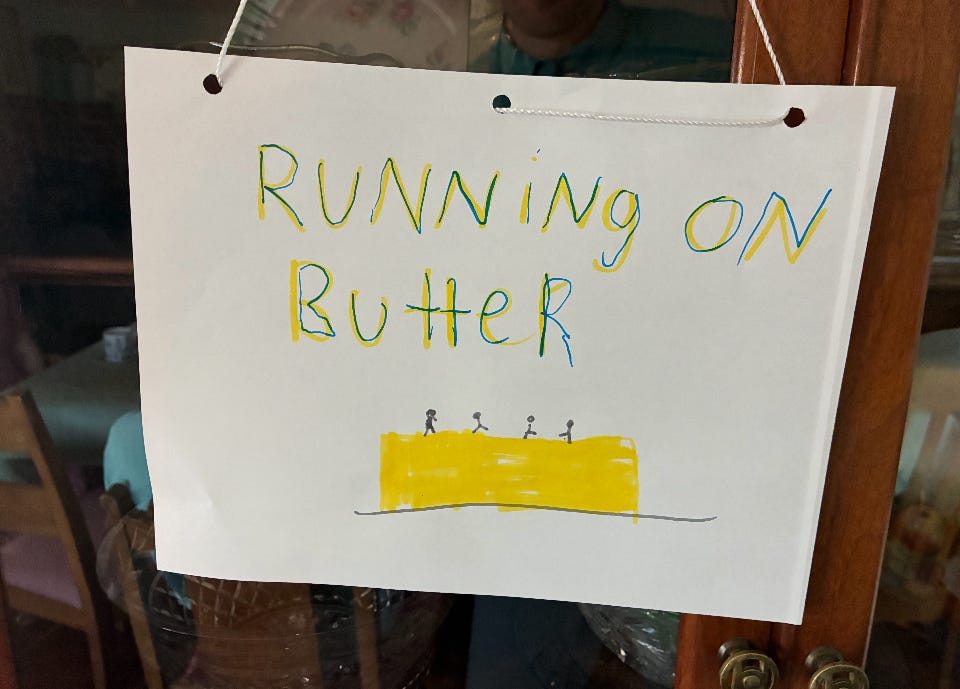
Hello everyone, and welcome to another year of Running On Butter. I’d like to give a special shout-out to my LDL cholesterol for driving me through the absolute banger that was 2025.
There is so much to be grateful for from last year—far too much to list. But one thing I will name is you: the Buttercups. Thank you for reading my writing. Y’all are the coolest.
Which, now that I’m thinking more about it, I guess ROB is probably what’s making you cool, so I really only have myself to thank.
As we start this new year, I want to lay down seven ideas that have been percolating for the past several months that I’d love y’all to consider.
These are concepts that will set you up for a killer 2026, a year providing the most abundance and health yet.
Idea No 1: Don’t ask questions.
My mother often told my siblings and me that there is no such thing as a dumb question. 2025 proved her wrong.
It became the year of “just asking questions”—a phrase increasingly used not to signal curiosity or critical thought, but to disguise intellectual laziness as skepticism and absurdity as discernment.
This year, let’s sit down and shut up. Let’s listen and learn.
Let’s read books written decades or centuries ago. Because when we do—when we study life on the Western frontier or the customs of ancient Japan—we feed our minds with historical knowledge and wisdom, which, in my experience, only makes me realize how little I truly know and how uncertain I am of my own thinking.
The truth is, we are neither as smart nor as bright as we like to think. And asking dim, conspiracy-laden questions is ultimately a declaration of small-mindedness.
Another question we should euthanize this year? “Does this_______make me happy?”
It could be a job or city in or perhaps even a relationship you’re in.
This kind of inward-curling, self-serving fixation is wildly out of fashion, dear Buttercups. And worse, it makes you miserable. There’s compelling research showing that when “happiness” becomes our primary compass (and let’s be honest, it’s often just a euphemism for selfishness), we end up making short-sighted choices that lead, paradoxically, to unhappier lives.
So let’s say no to selfishness masquerading as happiness, and yes to meaning. Yes to deepening our ties with friends, family, and God. Yes to asking a better question: How can I make the people around me feel more valued, more seen, more loved?
Idea No. 2: Escape the algorithm.
Social media is where intelligence goes to die.
It’s not that it’s just a waste of time; it’s literally atrophying our brains, causing memory failure and worsening attention spans.
There’s something deeply inhuman about the social media phenomenon. I don’t think it’s optimal to, in the span of 0.7 seconds, scroll from what your old high school acquaintance is up to, to regime change in Syria, to a dance set to a Sabrina Carpenter song, to a carousel of “healthiest sources of protein.”
We’re addicted to the algorithm. First step to overcoming addiction? Admitting there’s a problem.
Idea No. 3: Invite boredom into your life.
Why does everyone suddenly have collective amnesia about what childhood was like before iPads?
Parents today say things like, “I don’t know how we’d survive a road trip without their tablets.”
Deep breaths, Jessica. You—and literally all of human civilization—managed to grow up without 24/7 access to Cocomelon. Sweet Sadie and Cooper will survive a car ride with a few books (which are luxuries in their own right). And when those are finished and the whining begins, invite them to—gasp—look out the window.
Boredom isn’t a pathogen. But treating it like one erodes a child’s ability to think, imagine, and create.
I’m hardly innocent here. I treat boredom like a medical emergency. About 90% of my waking hours are spent reading, watching, or listening to something—anything—to avoid being alone with my own thoughts. The result? A diminished capacity for original thinking.
Running On Butter is making 2026 the Year of Boredom—for the kids, and for us adults too.
Idea No. 4: Create enemies.
I naturally and genuinely like most people. I can usually make friends with anyone, because almost everyone becomes interesting once you take the time to know them.
But last fall, I met someone I genuinely despised. He was a former marketer for a Big Food company and managed to embody the most dangerous pairing of traits imaginable: arrogance and ignorance.
I was actually eager to learn from him. Given his years inside Big Food, I asked what he made of the rise of MAHA and Americans’ growing interest in healthier food, and whether the industry felt any pressure to course-correct.
He waved it off as “all hype” and dismissed RFK Jr. as a “quack.”
When I asked what, specifically, made RFK Jr. a quack, he replied: “He’s trying to connect the measles vaccine to… what is it? What’s that condition called?” Seven seconds of verbal fumbling followed. I watched, enjoying as he dug his own rhetorical grave, before he finally landed on: “…Alzheimer’s.”
I looked at him, smiled. Said nothing.
This man, however, muttonheaded as can be, is not my enemy. I hold no bitterness toward him.
But that conversation did remind me of something important: the real enemies still need to be named—and relentlessly so.
MAHA is winning, and I love to see it. But we mustn’t get complacent. Buttercups: Let’s keep calling out these three recidivists when we see them in the grocery store:
Seed oils
Refined sugar and refined flour
Synthetic sweeteners
Idea No. 5: Stigmatize inactivity.
Running On Butter posits that movement is for all people, and that inactivity should be named and shamed. Movement is for:
The 8-year-old boy who hates math.
The teenage girl with boy problems.
The law student who’s busy with law review.
The electrician with knee pain.
The software engineer who sits at a desk 8 hours a day.
The nurse working the night shift.
The dad stressed with bills to pay.
The pregnant mom who’s stressed about her husband paying the bills.
The grandmother with a quiver full of grandchildren questioning whether her daughter should’ve married for love or for money.
Running On Butter promotes all types of exercise.
Whether it’s overhead weights or overhead serves, playing tag or leg day, pickleball or gardening to can pickles, sidewalk hopscotch or surfing, competitive cheer or hunting deer, running for Team USA or running from your past, pumping dumbbells or getting your revenge body after breaking up with a dumb guy, climbing a mountain or climbing the border wall, resistance training or resisting arrest, pole vaulting or pole danc—
Okay, wait. Maybe ROB doesn’t promote all forms of exercise. I’ll bring this up in the next board meeting.
The point is: normalize being active.
Idea No. 6: Eradicate slop music.
The K-pop song “Golden” came on in the grocery store the other day, and I found myself questioning the trajectory of Western civilization yet again. It sounds like it was written by a culturally illiterate, spiritually depleted seven-year-old wearing a unicorn backpack and a bedazzled “Daddy’s Princess” T-shirt.
From the chorus:
We’re goin’ up, up, up, it’s our moment
You know together we’re glowin’
Gonna be, gonna be golden
Oh-oh-oh, up, up, up with our voices
T.S. Eliot, is that you?
Now, listen. I’m no prude when it comes to music. I love a well-written, well-produced pop song. But much of what’s currently charting—pop, country, and yes, even Christian—is melodically simplistic and lyrically hollow. Tell me, sincerely: what exactly does “gonna be, gonna be golden” mean to you?
ROB is also openly hostile to the very concept of “children’s music.” It’s sonic high fructose corn syrup. There is only good music and bad music, and most so-called “kids’ music” is, objectively, slop.
I can already hear the parents protesting: “But Sadie just loves the Moana soundtrack,” and “Cooper goes crazy for Baby Shark.”
Tell me, Jessica—who showed Sadie and Cooper that slop in the first place? Did they stumble upon it organically, like ethnomusicologists? Or did it come through your Spotify account?
Get another grip. You’re the one with the aux cord. You’re the parent.
You largely decide what your children are interested in because you are, quite literally, constructing their reality. Taste isn’t innate; it’s cultivated. And in this house, we listen to Bach and Oscar Peterson.
Idea No. 7: Eat butter.
Okay, maybe this isn’t exactly breaking news for ROB. But we should never grow weary of the fact that butter is genuinely one of the healthiest foods you can eat.
Refresher of butter’s goodness:
Fat-soluble vitamins: A, D, E, K₂ (especially grass-fed) → immune, bones, calcium balance.
Saturated fats → hormone production, cell integrity, satiety.
Butyrate → feeds gut cells, reduces inflammation, may improve insulin sensitivity.
Cholesterol → brain, nerves, hormone precursor.
CLA (grass-fed) → fat metabolism, anti-inflammatory, potential anti-cancer benefits.
Stable cooking fat → resists oxidation unlike industrial seed oils.
Whether you’re a mom (hi, Jessica!), a gym bro, or a grandma, butter deserves a starring role in your diet. Unsure where to start? Slap a generous slab on your roasted veggies.
More butter = more health.
Took my kids ages 6, 4, and 2 on a 6000 mile road trip this summer. No tablets. Look out the window or listen to audiobooks together. Character building
Best SS post of 2026 👏 (Thus far)